FROM ONE LIFE TRANSFORMED TO THOUSANDS EQUIPPED
Artificial intelligence changed the trajectory of one working life.
After nearly two decades between his first published book in 2005 and his return to publishing in 2024, RESOURCE GATE AI LAB founder Isaac Gichina Njuguna began incorporating artificial intelligence into his research, writing and creative workflow.
The results opened possibilities far beyond writing alone. AI became a practical tool for research, publishing, digital content creation, visual communication, documentary development, filmmaking exploration and other forms of knowledge work.
But the experience raised a much bigger question:
What could happen if practical AI knowledge became accessible to thousands of people whose abilities, ideas and potential are present—but whose opportunities to develop them are limited?
RESOURCE GATE AI LAB was born from that question.
Our founding conviction is simple:
Access to practical AI knowledge can unlock abilities, opportunities and productive capacity that might otherwise remain dormant.
What began with one person’s transformation now provides the foundation for a structured pathway through which others can learn, build, demonstrate and multiply their skills.
Our ambition therefore extends beyond teaching people how to use AI tools.
We help people discover what they can build with them.
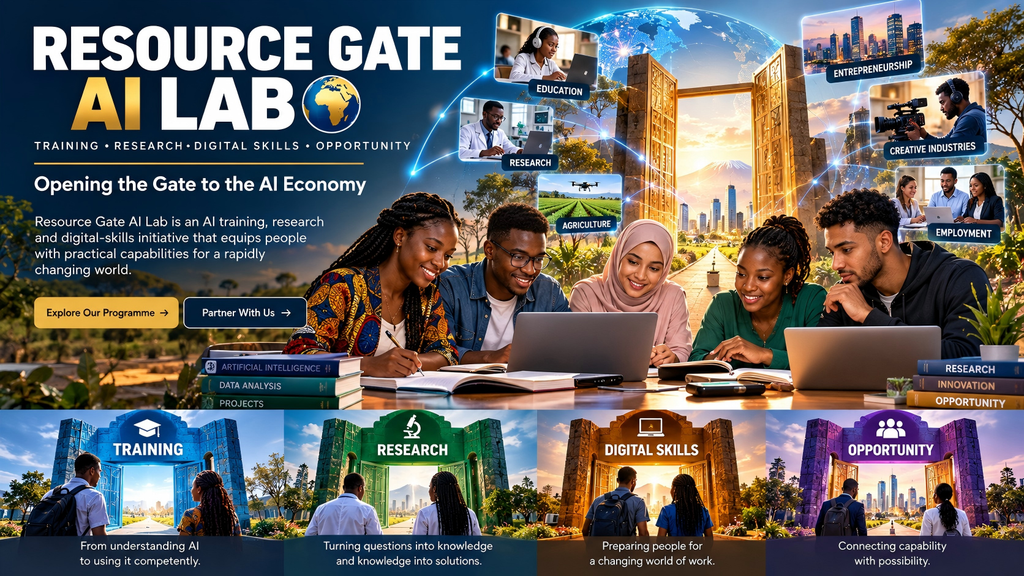
WHAT WE DO — FOUR GATES TO OPPORTUNITY
RESOURCE GATE AI LAB operates around four interconnected pillars: Training, Research, Digital Skills and Opportunity.
TRAINING
From understanding AI to using it competently.
Professional training moves learners from AI fundamentals to practical application. Learners create, research, analyse, solve problems and produce demonstrable work. Our training covers AI foundations, prompting and generative AI, research, data skills, introductory programming and Python, automation, AI-assisted productivity and practical applications.
Internationally recognized learning resources and appropriate external credentials complement our project-based training. But certificates are not the objective alone. Every learner should be able to demonstrate what he or she has learned through practical work, projects and a developing professional portfolio.
The goal is competence that can be demonstrated.
RESEARCH
Evidence that informs decisions. Insights that guide action.
RESOURCE GATE AI LAB provides research and advisory services for businesses, public institutions, development organisations and communities. Our work spans market and consumer research, social and public-opinion research, economic and business research, agriculture and agribusiness, programme monitoring and evaluation, and technology and AI.
We help clients investigate important questions, assess opportunities and make informed decisions through appropriate research methods, careful analysis and clear reporting. Each assignment is shaped around the client’s objectives, timeframe and intended use of the findings.
Explore Our Research & Advisory Services
DIGITAL SKILLS
Preparing people for a changing world of work.
RESOURCE GATE AI LAB combines AI education with the broader digital capabilities people need to participate effectively in today’s economy. These include research, data literacy, professional communication, digital productivity, introductory coding and the intelligent use of emerging technologies.
Our emphasis remains practical. We continually ask: Can the learner use the skill? Can the learner demonstrate it? Can the learner apply it to a real problem? Knowledge becomes more valuable when it can be translated into productive capability.
AI becomes most valuable when knowledge becomes practical capability.
OPPORTUNITY
Connecting capability with possibility.
RESOURCE GATE AI LAB connects learning with pathways toward employment, entrepreneurship, further education, research, professional networks, scholarships and service.
We seek relationships with technology companies, educational institutions, employers, foundations, development organizations and other partners that can help expand access and opportunity. Scholarships are especially important because financial circumstances should not prevent promising learners from developing valuable capabilities.
Talent should not remain dormant simply because opportunity was absent.
RESOURCE GATE PROFESSIONAL LEARNING PATHWAY
SIX MONTHS. SIX STAGES. ONE PROFESSIONAL JOURNEY.
RESOURCE GATE AI LAB is designed around a progressive six-month professional learning pathway. Learners move from understanding artificial intelligence to applying it, building with it, investigating real-world problems and presenting evidence of what they can do.
Our educational principle is simple:
Every stage of learning must produce evidence of learning.
Internationally recognized credentials can strengthen a learner’s professional profile, but collecting certificates is not our final objective. At RESOURCE GATE AI LAB, credentials should be accompanied by practical evidence of competence.
By the end of the pathway, every learner should be able to say:
Here is what I learned.
Here is what I built.
Here is the problem I investigated.
Here is my project.
And here is my professional portfolio.
MONTH 1 — AI FOUNDATIONS
Understand the technology before learning to build with it.
Learners begin by developing a strong foundation in artificial intelligence, generative AI, responsible use, opportunities, limitations and practical applications. They learn what AI can do, what it cannot reliably do, and why human judgment, verification and responsible use remain essential.
During this stage, learners also begin an appropriate internationally recognized foundational learning pathway alongside RESOURCE GATE AI LAB practical exercises.
Evidence of Learning: Foundational credential + practical AI exercises.
MONTH 2 — PROMPTING & GENERATIVE AI
Moving from asking AI questions to working with AI deliberately.
Learners develop practical skills in structured prompting and the productive use of generative AI for research, communication, ideation, analysis, productivity and problem-solving. They learn how clearer instructions, appropriate context and thoughtful follow-up can improve the quality of AI-assisted work.
Particular emphasis is placed on critical thinking, fact-checking, responsible use and human judgment. Learners are taught not simply to accept AI-generated answers, but to question, verify, refine and apply them appropriately.
Evidence of Learning: Structured prompting portfolio + practical generative AI assignments.
MONTH 3 — DATA & CODING FOUNDATIONS
Learning to work with data, logic and introductory programming.
Learners are introduced to data literacy, computational thinking and basic programming, including Python. The objective is not to turn every learner immediately into a software engineer, but to develop the ability to understand data, think logically and use coding as a practical tool for solving problems.
Through guided exercises, learners begin working with data, simple scripts and introductory automation. They learn how coding and AI can work together to increase productivity, analyse information and support practical tasks.
Evidence of Learning: Data project + introductory Python and coding exercises.
MONTH 4 – BUILD WITH AI
Moving from AI user to AI builder.
Learners now apply what they have learned to create something functional. Depending on their interests and developing skills, they may build a simple chatbot, automation, research assistant, data application, digital workflow or another AI-assisted solution.
The emphasis is on learning by building. Learners identify a practical need, design a solution, test it, improve it and demonstrate how it works. This stage develops confidence in turning ideas into useful applications.
Evidence of Learning: A working AI-assisted application or practical solution.
MONTH 5 – COUNTRY REAL-WORLD CAPSTONE
From learning technology to solving real problems.
Learners identify a genuine challenge affecting a community, organization, industry or sector within their own country. They research the problem, examine available evidence and explore how artificial intelligence or other digital technologies might contribute to a practical response.
The capstone follows a practical progression: IDENTIFY → RESEARCH → DESIGN → BUILD → TEST → PRESENT.
The objective is not to produce an impressive report that simply sits on a shelf. Learners are challenged to develop, test and present a practical response to a real-world problem while documenting what they discovered along the way.
Evidence of Learning: Country Real-World Capstone Project.
MONTH6 – PORTFOLIO TO OPPORTUNITY
Turning demonstrated capability into professional opportunity.
In the final month, learners bring together their projects, credentials, research and practical work into a professional portfolio. They develop their CV, online professional presence, presentation skills and the ability to communicate clearly what they have learned, built and accomplished.
Learners prepare to present their capabilities to employers, clients, educational institutions, professional networks and other opportunity providers. The emphasis is no longer simply on saying, “I completed a course,” but on being able to demonstrate, “This is what I can do.”
Evidence of Learning: Completed professional portfolio + capstone presentation.
Graduates who demonstrate strong competence, practical ability, responsible use of AI and the capacity to communicate what they have learned may progress toward RESOURCE GATE AI LAB’s Train-the-Trainer pathway.
The question at the end of the journey is therefore not only, “What have you learned?” but also, “How many people could you eventually help to equip?”
TRAIN-THE-TRAINER NETWORK
TRAIN ONE. EQUIP MANY.
Knowledge reaches its greatest value when it does not stop with the person who received it.
RESOURCE GATE AI LAB believes that meaningful educational impact should extend beyond individual achievement. Our Train-the-Trainer Network is designed to prepare competent graduates to share their knowledge, mentor others and help expand access to practical artificial intelligence and digital skills.
Through this model, one well-trained learner may eventually become a source of knowledge and opportunity for many others. As the network develops, qualified trainers can help bring practical AI education closer to communities, institutions and individuals who might otherwise have limited access.
The network will emphasize demonstrated competence, responsible AI use, effective communication and the ability to guide others through practical learning. Completing the six-month programme alone will not automatically qualify someone to become a trainer. Candidates must demonstrate both technical ability and the capacity to teach.
FIVE STAGES OF THE TRAIN-THE-TRAINER NETWORK
The RESOURCE GATE AI LAB Train-the-Trainer model follows five interconnected stages: LEARN → DEMONSTRATE → QUALIFY → TRAIN → MULTIPLY. Each stage builds upon the previous one, ensuring that knowledge is transferred through demonstrated competence, responsible practice and effective teaching.
STAGE 1 — LEARN
Prospective trainers first complete the RESOURCE GATE AI LAB professional learning pathway or demonstrate equivalent competencies. They develop a foundation in artificial intelligence, prompting, research, data literacy, digital skills, introductory programming and practical AI applications.
Learning is supported by practical assignments, projects and appropriate internationally recognized educational resources. The emphasis is on understanding and application rather than attendance alone.
Expected Outcome: A learner with foundational knowledge and demonstrated practical skills.
STAGE 2 — DEMONSTRATE
Knowledge must be demonstrated through practical application. At this stage, prospective trainers present evidence of their competence through completed assignments, working projects, research activities and their professional portfolios.
Candidates may be asked to explain their work, demonstrate a functioning AI-assisted solution and show how they approached a real-world problem. The emphasis is on independent understanding, practical ability and responsible use of technology.
Expected Outcome: A candidate who can demonstrate practical competence and explain how their work was developed.
STAGE 3 — QUALIFY
Demonstrated technical competence is an essential foundation, but effective teaching requires additional preparation. Candidates seeking to join the RESOURCE GATE AI LAB Train-the-Trainer Network undergo further assessment of their communication skills, instructional ability, professional conduct and understanding of responsible AI practices.
Suitable candidates progress through a focused trainer-preparation programme that includes lesson planning, practical demonstrations, learner assessment, mentoring techniques and supervised teaching exercises. The objective is to prepare trainers who can communicate complex ideas clearly and guide learners toward measurable competence.
Trainer qualification is based on demonstrated readiness rather than automatic progression. Candidates must show that they can explain concepts accurately, conduct practical learning activities, assess learner progress and provide constructive guidance.
Expected Outcome: A qualified trainer candidate who has demonstrated the knowledge, practical skills and instructional ability required to teach effectively.
STAGE 4 — TRAIN
Qualified trainers guide learners through structured lessons, practical demonstrations and supervised projects. They help learners understand concepts, practise skills, question AI-generated outputs and apply what they learn responsibly.
Trainers assess progress through demonstrable work, give constructive feedback and support learners who need additional guidance. Shared teaching materials, mentoring and periodic review help maintain consistent standards across the network.
Expected Outcome: A trainer who can guide learners toward practical competence and assess their work fairly.
STAGE 5 — MULTIPLY
The network grows as capable trainers help equip others in their communities, institutions and professional networks. Each new learning group creates an opportunity to extend access to practical AI knowledge and digital skills.
Growth follows demonstrated readiness. Experienced trainers help identify and mentor future trainers, while RESOURCE GATE AI LAB reviews teaching quality, learner work and feedback to strengthen the programme.
Success is measured through the capabilities learners demonstrate, the useful work they produce and their ability to pass knowledge on responsibly.
Expected Outcome: A growing network that expands access to learning while maintaining practical competence, responsible teaching and consistent standards.
CONNECT WITH RESOURCE GATE AI LAB
Build practical skills. Investigate important questions. Help open opportunities.
Whether you want to develop your AI and digital capabilities, commission a research assignment or explore working with us, we welcome your enquiry.
Training Enquiries
Ask about our professional learning pathway and Train-the-Trainer Network.
Research & Advisory Services
Explore our research services and discuss the questions your organisation needs to answer.
Partnership Enquiries
Discuss opportunities to support learning, contribute expertise or extend access within your community or institution.